Felt Jurisdiction
Translation is admissible only where distinction survives the transfer.
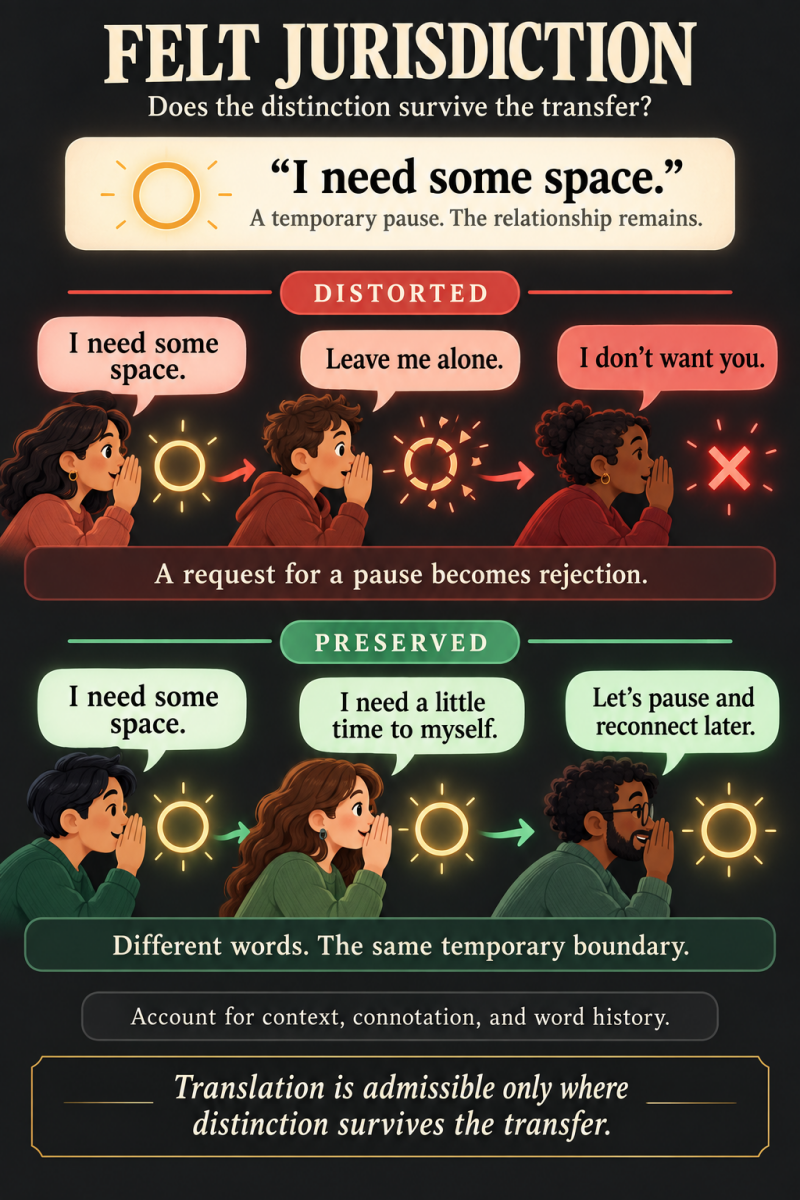
Literal translation alone is not enough. Semantic precision is not enough. Effective communication must also account for the connotations, histories, social uses, and emotional associations of the words being said.
A word carries more than its definition. It enters a conversation with associations that can affect what a listener understands, what they expect, and what they believe the speaker has claimed. These associations participate in meaning. They can preserve a distinction, obscure it, or replace it with another.
Within the System of No, Felt Jurisdiction concerns the contextual authority and limits of these associations in communication. It asks whether the language used allows the intended distinction to remain legible in the register where it is received.
Precision and Reception
A statement can be precise within the speaker’s vocabulary and still communicate something different to its audience.
Two words may share a dictionary definition while carrying different implications. One may suggest care; another, control. One may name belonging; another may invoke ownership. A term used neutrally within one community may carry a history of humiliation, coercion, or exclusion within another.
Choosing a formally equivalent word does not settle whether the meaning has survived.
The receiving term must be considered in its own context: what it has meant, how it is used, which concepts surround it, and what distinctions it makes available to the people hearing it.
What Must Survive?
Preserving distinction means preserving the relationships and limits that make a claim what it is.
If a statement distinguishes care from possession, its translation must keep that difference legible. If it describes refusal as the preservation of a boundary, the receiving language must not silently convert that refusal into hostility. If it expresses uncertainty, it must not arrive as denial or certainty.
The vocabulary may change. The explanation may need to change. An unfamiliar term may require an example or an explicit qualification.
What must survive is the distinction being communicated.
This applies across languages, cultures, disciplines, communities, and individual vocabularies. It also applies when an idea moves into fiction: a character can express a proposition through their own experience and language while preserving its structure.
Feeling Has Jurisdiction—and Limits
The associations a word evokes matter because they affect reception. Their relevance does not make every interpretation decisive.
A listener’s reaction can reveal an ambiguity, a historical burden, or a mismatch between intended and received meaning. It does not, by itself, establish the speaker’s intention or settle the truth of the claim.
Likewise, a speaker’s precise intention does not guarantee successful communication.
Felt Jurisdiction requires both to remain legible: what the speaker is saying and what the chosen language communicates under the conditions of its reception. Where those diverge, the divergence must be examined.
Reconstruction Before Rebuttal
This is why Felt Jurisdiction connects to Cognitive Fencing.
Before contesting a claim, reconstruct it in terms its speaker can recognize and accept. A familiar word may conceal an unfamiliar distinction. An unfamiliar vocabulary may carry a recognizable proposition.
Reconstruction tests whether the claim survived the transfer between speakers. Without that check, a rebuttal may address an association introduced by the listener rather than the proposition presented by the speaker.
Preserved Distinction Across Transmission
The System of No does not require universal vocabulary. It requires communication that preserves the distinctions on which a claim depends.
Definitions establish part of that work. Context, connotation, and history establish further conditions of legibility.
Effective communication accounts for what words mean, what they carry, and what they become in reception.