The Mechanics of Leverage
In finance, leverage often means borrowed exposure: "using debt, margin, or other instruments to magnify gain and loss."
That is not the only meaning being used here.
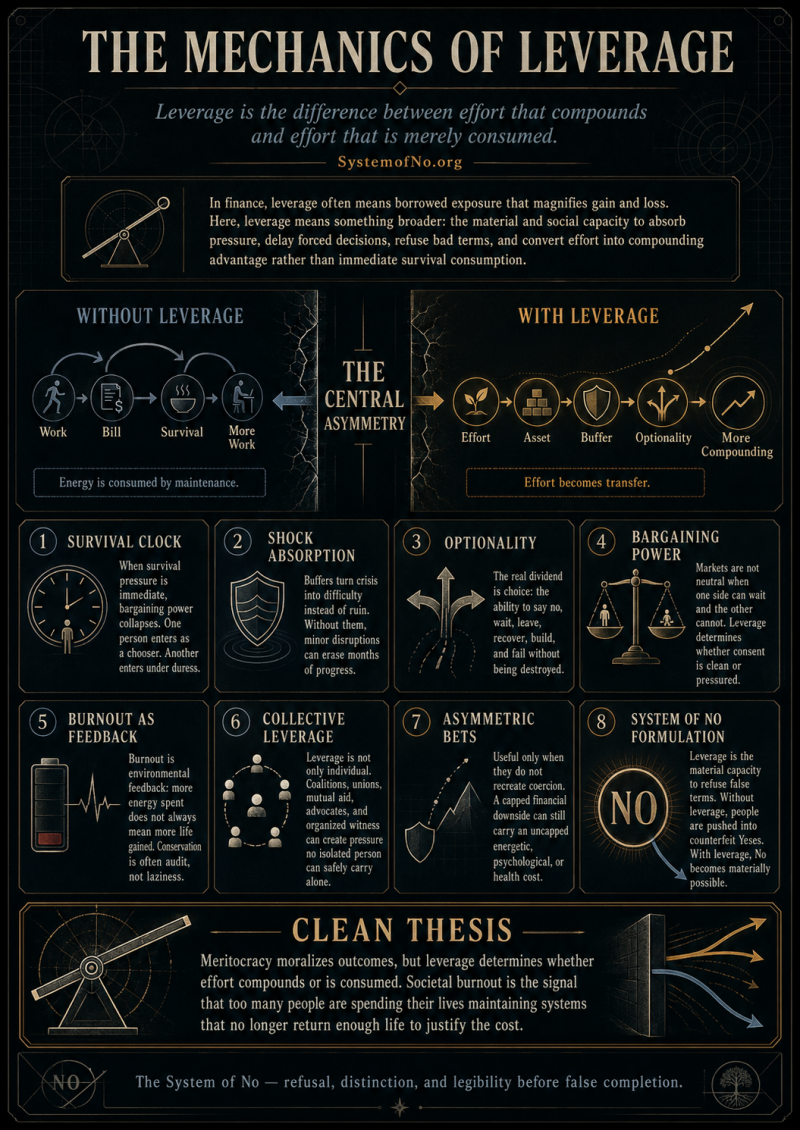
In this essay, leverage means the broader material and social capacity to absorb pressure, delay forced decisions, refuse bad terms, and convert effort into compounding advantage rather than immediate survival consumption.
Debt can function as leverage only when it expands optionality without transferring control back to the lender.
When it increases obedience, panic, extraction, or dependency, it is not leverage in the System of No sense. It is capture.
Leverage is the difference between effort that compounds and effort that is merely consumed.
It is not just money. It is the structural capacity to absorb shocks, delay decisions, refuse bad terms, and place energy where it can multiply instead of vanish into survival maintenance.
1. The Survival Clock
The first mechanic is time pressure.
A person with money, housing stability, health, family support, credentials, or savings can wait. They can reject a bad job, negotiate, recover, study, build, relocate, or take a calculated risk.
A person without those buffers cannot wait.
Rent, food, bills, transportation, medication, debt, and emergencies create immediate demand.
So the market does not meet both people equally.
One person enters the market as a chooser.
The other enters under duress.
That is why “just work harder” is structurally dishonest.
The same labor has different bargaining power depending on how close the person is to collapse.
2. Shock absorption
Assets function as insulation.
With leverage, a crisis is expensive but survivable. A car repair, medical bill, job gap, or failed attempt hurts, but it does not necessarily destroy the whole trajectory.
Without leverage, a minor disruption can erase months of progress.
That means poverty is not merely “having less.” It is living in a condition where ordinary events become catastrophic because there is no buffer between inconvenience and ruin.
The progress bar resets because surplus cannot accumulate long enough to become capital.
3. Optionality
Wealth buys choices.
Not luxury first. Choice.
The choice to say no.
The choice to rest.
The choice to wait.
The choice to leave.
The choice to take a lower-paying opportunity with long-term upside.
The choice to build something before it pays.
The choice to fail without being destroyed.
This is the true dividend of passive income or accumulated assets: distance from coercion.
Passive income matters because it weakens the link between immediate obedience and survival. It gives the person room to act strategically instead of reactively.
4. Compounding versus Consumption
This is the central asymmetry.
With leverage, effort can become an asset.
You write once; it sells repeatedly.
You invest once; returns begin accumulating.
You learn a skill; it raises future earning power.
You build a network; opportunities come back later.
You buy property; appreciation and equity may accumulate.
You create a system; it keeps producing after the initial labor.
Without leverage, effort is often consumed immediately.
Work pays the bill.
The bill preserves survival.
Survival allows more work.
More work pays the next bill.
Nothing compounds. The person is not lazy. Their energy is being converted directly into maintenance.
That is the treadmill: motion without transfer.
5. Bargaining Power
Market freedom is partly fictional when one side can wait and the other cannot.
If an employer can leave a position open for three months but the worker cannot miss one paycheck, the negotiation is not neutral.
If a landlord can absorb vacancy but the tenant cannot absorb homelessness, the contract is not neutral.
If a lender can price risk but the borrower needs the money immediately, the agreement is not neutral.
Leverage determines whether consent is clean or pressured.
System language:
A Yes given under survival compression is not always a sovereign Yes.
6. Meritocracy as Cover Story
Meritocracy says outcomes reflect effort, discipline, talent, and responsibility.
Leverage reveals the missing variables:
health, time, housing, family support, inheritance, transportation, location, debt, credentials, legal status, social network, institutional access, and the ability to survive delay.
The myth does not have to deny effort. It only has to isolate effort from its conditions.
That is the smuggling operation.
It turns structural advantage into virtue and structural deprivation into personal failure.
7. Burnout as Environmental Feedback
Burnout is what happens when effort repeatedly fails to produce transfer.
The body learns the equation before ideology admits it: "More energy spent does not equal more life gained."
So the organism conserves.
That conservation may look like apathy, avoidance, dropout, detachment, cynicism, underemployment, or refusal, but at scale, it is not merely individual pathology. It is a population reading the reward structure.
"An organism that conserves energy when effort no longer pays is functioning exactly as it should."
That is not collapse. That is audit.
8. Collective leverage
Leverage is not only individual.
When a person lacks money, credentials, savings, institutional access, or family support, leverage can sometimes be built collectively.
A union, coalition, community network, public record, legal advocate, shared refusal, or organized witness can create pressure that no isolated person could create alone.
This matters because the absence of individual leverage does not mean the absence of all possible power. It means the person cannot safely carry the lever alone.
Collective leverage works when isolated survival pressure is redistributed into shared visibility, shared cost, shared refusal, and coordinated demand.
But collective leverage can also become capture if the group consumes the person it claims to protect. A coalition is valid only when it increases the member’s capacity to refuse false terms, not when it replaces one form of coercion with another.
9. The trap in “asymmetric bets”
Asymmetric bets can be useful, but only when they do not recreate the coercion they are supposed to escape.
Digital assets, micro-investing, low-cost experiments, and side projects can create real upside. But they become hustle ideology when the starting conditions are ignored.
A capped financial downside is not the same as a capped energetic, psychological, relational, or health downside.
Lost sweat equity is not free when energy is scarce.
Distribution cost being low does not mean attention cost is low.
Creating something once does not mean it will compound. Visibility, platform access, consistency, marketing, audience trust, timing, and recovery capacity are also leverage problems.
The question is not merely: “Could this pay off?”
The better question is: “Can this be attempted without converting the person into fuel?”
10. The System of No formulation
Leverage is the material capacity to refuse false terms.
Without leverage, people are forced to accept counterfeit Yeses:
yes to bad work,
yes to debt,
yes to exhaustion,
yes to institutional scripts,
yes to “next thing” logic,
yes to proving worth through depletion.
With leverage, No becomes materially possible.
That is why wealth is not just accumulation. It is jurisdiction.
It determines whether your life is governed by choice, delay, strategy, and recovery — or by immediate extraction.
Clean thesis
The mechanics of leverage explain why effort does not produce equal outcomes. Meritocracy moralizes the result, but leverage determines whether effort compounds or is consumed. Societal burnout is the collective signal that too many people are spending their lives maintaining systems that no longer return enough life to justify the cost.