Authorization in the System
Warrant, Jurisdiction, and the Laundering of Value Judgments
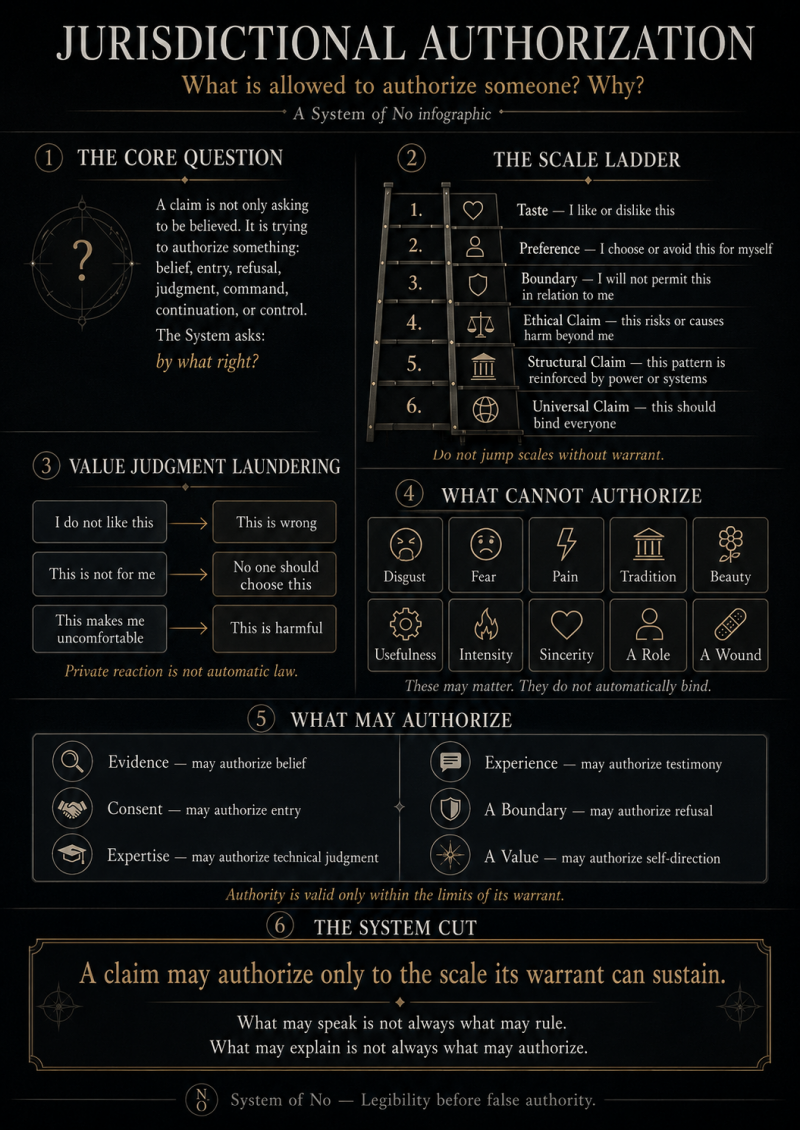
The System of No does not only ask whether a claim is true.
It asks what the claim is trying to authorize.
A claim is rarely neutral once it enters relation, law, identity, ethics, politics, technology, intimacy, or belief.
It begins to grant permission.
It tells someone what may be believed, what may be refused, what may be demanded, what may be dismissed, what may be punished, what may be loved, what may be entered, and what may be treated as real.
For that reason, authorization is one of the central questions of the System.
By what authority does this claim speak?
What does it permit?
Who gains power if it is accepted?
What does it erase, compel, excuse, rename, or enclose?
What standard is being invoked?
And does that standard have jurisdiction here?
Without authorization, truth becomes appetite wearing formal clothing. Refusal becomes preference dressed as principle. Yes becomes relief disguised as consent. Ethics becomes disgust with better vocabulary.
The System of No audits authorization so that a private reaction does not become false law.
I. What Authorization Means
Authorization is the right to bind, admit, refuse, continue, judge, or command within a specific jurisdiction.
It is not the same as intensity.
It is not the same as sincerity.
It is not the same as pain.
It is not the same as beauty, tradition, usefulness, fear, desire, charisma, majority approval, or personal conviction.
All of these may matter. None of them automatically authorize.
A wound may explain a reaction. It does not automatically authorize harm.
A tradition may carry meaning. It does not automatically authorize coercion.
A desire may be real. It does not automatically authorize access.
A fear may be sincere. It does not automatically authorize control.
A role may reveal a perspective. It does not automatically authorize command.
A personal value may guide the self. It does not automatically bind the world.
Authorization requires warrant.
A claim must show why it has the right to operate at the scale it is attempting to occupy.
II. The Scale Problem
Many false claims begin as honest private reactions.
“I do not like this.”
“This frightens me.”
“This is not for me.”
“This violates my aesthetic."
“This does not fit my values.”
“This makes me uncomfortable.”
These statements may be valid at the level of taste, preference, boundary, or personal orientation.
The problem begins when they are smuggled upward without warrant.
“I do not like this” becomes “This is wrong.”
“This is not for me” becomes “No one should choose this.”
“This makes me uncomfortable” becomes “This is harmful.”
“This violates my values” becomes “This is invalid.”
“This arrangement does not fit my life” becomes “This arrangement is degrading.”
That movement is not automatically illegitimate. Some private reactions may point toward real harm, but the movement must be audited.
A claim does not gain universal authority merely because it is emotionally forceful.
The System separates scale:
Taste says: "I like or dislike this."
Preference says: "I choose or avoid this for myself."
Boundary says: "I will not permit this in relation to me."
Ethical claim says: "this causes or risks harm beyond me."
Structural claim says: "this pattern is reinforced by power, incentives, institutions, or repeated conditions."
Universal claim says: "this should bind everyone."
Most counterfeit authority comes from jumping scales without paying the cost of proof.
III. Value Judgment Laundering
Value judgment laundering occurs when a person disguises a preference, fear, disgust, wound, aesthetic, ideology, or personal need as a higher authority than it has earned.
It is not dishonest to have values.
It is dishonest to hide their scale.
A person may say: “I personally do not want this kind of relationship.”
That is a preference.
But if they say: “This kind of relationship is inherently invalid,” they have made a stronger claim. They now owe warrant.
A person may say: “I want a traditional domestic life.”
That is self-authorship.
But if they say: “Women are most natural when they submit to domestic roles,” they have laundered personal desire into gender law.
A person may say: “I am uncomfortable with sex work.”
That is a reaction.
But if they say: “Sex work is inherently degrading and no one can choose it meaningfully,” they have made a universal and structural claim. They now owe evidence that does not erase or infantilize the worker’s autonomy.
A person may say: “My attraction has a strong preference.”
That is desire distribution.
But if they say: “Uneven attraction means bisexuality is fake,” they have turned their need for simplified categories into ontology.
The System does not forbid judgment.
It requires judgment to identify its jurisdiction.
IV. What Cannot Authorize
Not every force that feels powerful has authority.
Pain cannot authorize total control.
Disgust cannot authorize moral condemnation.
Love cannot authorize possession.
Fear cannot authorize captivity.
Usefulness cannot authorize dependency.
Creation cannot authorize ownership.
Tradition cannot authorize coercion.
Beauty cannot authorize truth.
Intensity cannot authorize scale.
Sincerity cannot authorize accuracy.
A role cannot authorize exemption.
A wound cannot authorize a regime.
These things may become evidence. They may become context. They may become warnings. They may become reasons to pause, investigate, refuse, or revise.
They do not automatically bind.
The System distinguishes between what may speak and what may rule.
V. What May Authorize
A thing may authorize only within the limits of its warrant.
Evidence may authorize belief, but only to the degree the evidence supports.
Consent may authorize entry, but only under revocable and specific terms.
Expertise may authorize technical judgment, but not total social authority.
Experience may authorize testimony, but not universal law.
A boundary may authorize refusal, but not domination.
A role may authorize function, but not immunity from audit.
A system may authorize procedure, but not truth beyond its jurisdiction.
A community may authorize norms, but not the erasure of distinction.
A value may authorize self-direction, but not compulsory application to others.
Authority is valid only when it remains bounded, legible, accountable, and proportionate to its domain.
VI. The Role Problem
Roles are especially dangerous because they can feel like authorization.
The victim-role may authorize testimony, but not automatic innocence in every later conflict.
The teacher-role may authorize instruction, but not obedience.
The healer-role may authorize care, but not access.
The leader-role may authorize coordination, but not possession.
The artist-role may authorize creation, but not immunity.
The founder-role may authorize origin, but not absolute ownership of meaning.
The rebel-role may authorize refusal, but not reflexive opposition to every structure.
A role becomes counterfeit when it stops revealing a position and starts protecting a person from audit.
The System permits role-entry as a diagnostic instrument.
It does not permit the role to become a throne.
VII. The Central Question
The System of No asks:
What is allowed to authorize someone?
Why?
At what scale?
Under what conditions?
With what limits?
And when does the claim stop being truth and start becoming a private value judgment wearing borrowed law?
This is not relativism. It is jurisdictional discipline.
The System does not say all claims are equal. It says claims must show the authority by which they speak.
A claim that cannot identify its warrant may still be a feeling.
It may still be a preference.
It may still be a wound.
It may still be a wish.
It may still be a fear.
It may still be a value.
But it may not govern beyond what it has earned.
VIII. Clean Formulation
Authorization in the System of No is the discipline of determining what has the right to bind, admit, refuse, judge, command, or continue within a given jurisdiction. A claim may authorize only to the scale its warrant can sustain. Taste must not pretend to be ethics. Disgust must not pretend to be evidence. Pain must not pretend to be sovereignty. Tradition must not pretend to be law. Desire must not pretend to be consent. Usefulness must not pretend to be trust. Creatin must not pretend to be ownership.
The System does not abolish value judgments.
It forces them to stand at the correct scale.
What may speak must be distinguished from what may rule.
What may explain must be distinguished from what may authorize.
What may matter must be distinguished from what may bind.
The System of No audits authorization because false authority is one of the oldest forms of capture.
No asks what must be refused.
Authorized Yes asks what may enter.
Authorization asks by what right anything claims the power to decide.