Survival Sorting and the Societal Collapse
When people say “capitalism is everywhere,” they are often not only naming an economic system. They are naming a mechanism.
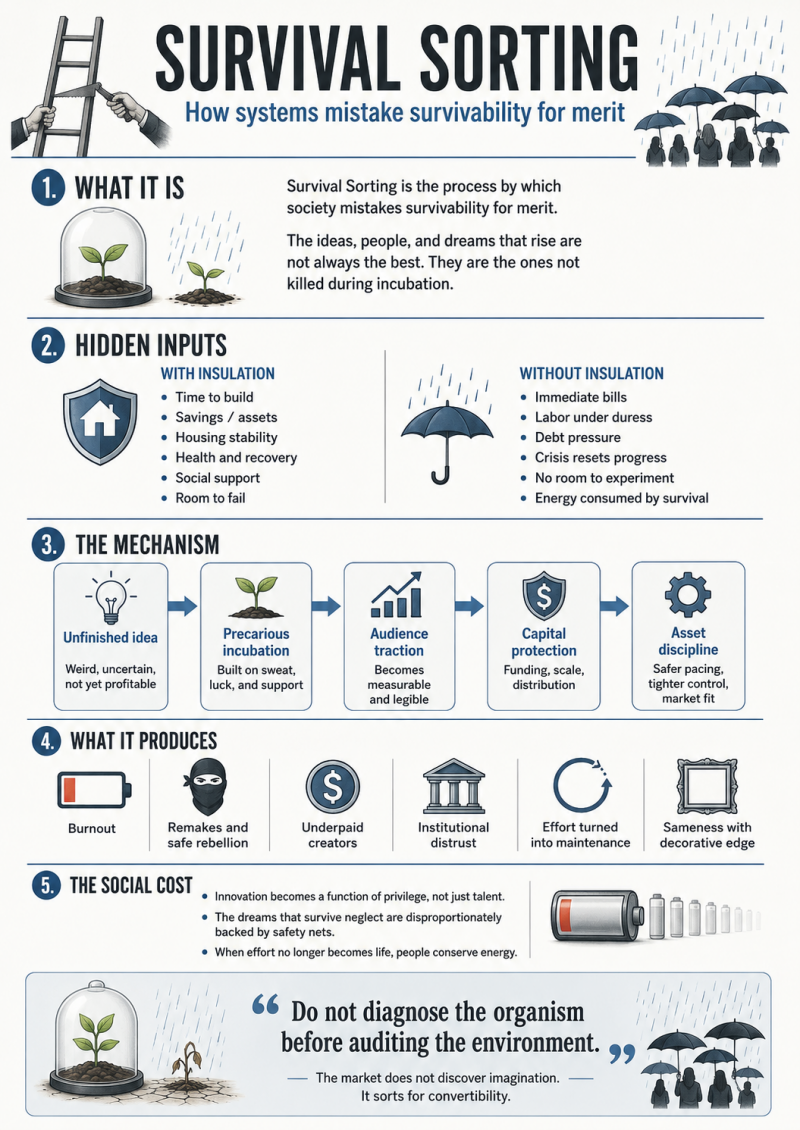
The mechanism of Survival Sorting is not merely buying, selling, markets, profit, or private ownership. Those are visible structures. The deeper mechanism is convertibility: the pressure to turn every human capacity, relation, dream, wound, idea, skill, and form of attention into something measurable, usable, scalable, and extractable.
This is why the phrase feels true even when the analysis is imprecise.
Capitalism is not literally everywhere as a formal economic model. But capital-logic has colonized the grammar of value. It teaches people to ask, often before they even know they are asking it:
Can this be monetized?
Can this be optimized?
Can this be branded?
Can this be made legible to institutions?
Can this be converted into leverage?
Can this survive long enough to become an asset?
That is the mechanism.
And one of its most brutal effects is Survival Sorting.
I. What Survival Sorting Is
Survival Sorting is the process by which society mistakes survivability for merit.
The ideas that reach visibility are not necessarily the best ideas. The artists who break through are not necessarily the most talented. The writers who finish are not necessarily the most profound. The founders who build are not necessarily the most visionary. The people who “make it” are not necessarily the most disciplined, deserving, or original.
They are the ones whose dreams survived the incubation period.
That survival may come from talent. But talent is only one input.
More often, survival depends on hidden infrastructure: family support, free time, health, housing stability, emotional bandwidth, social access, luck, legal safety, low debt, inherited confidence, proximity to opportunity, and enough insulation to fail without being destroyed.
A dream needs time before it becomes legible. A person needs room before they become useful. An idea needs an unfinished stage before it can become coherent.
But the modern world does not protect the unfinished stage. It starves it, mocks it, rushes it, disciplines it, and then, if it survives, calls the survivor inevitable.
That is Survival Sorting.
It does not select the best.
It selects the un-killed.
II. The Lie of Pure Merit
Meritocracy says effort produces reward.
Survival Sorting reveals the hidden clause:
Effort only compounds when the person has enough leverage to prevent effort from being consumed by survival.
Without leverage, effort is burned for maintenance.
The person works to pay the bill.
The bill preserves survival.
Survival allows more work.
More work pays the next bill.
There is motion, but no transfer. Energy circulates without becoming sovereignty.
With leverage, effort can become an asset. A person can write before publication. Study before promotion. Build before revenue. Rest before breakdown. Refuse bad terms. Wait for better ones. Take risks whose failure does not destroy them.
This is why wealth is not merely accumulated currency. Wealth is strategic optionality. It is the right to remain unfinished without being punished for not yet producing yield.
That right is distributed unequally.
So when society looks at who succeeded and calls it “merit,” it is often looking at the aftermath of unequal survival conditions.
The market does not simply discover excellence. It audits imagination for convertibility, then calls the survivors talented.
III. The Collapse of Imagination
Imagination is one of humanity’s primary survival organs. It allows a species to see beyond immediate conditions. It creates art, law, myth, technology, ritual, language, strategy, and new social forms. It lets people ask not only “What is?” but “What else could be?”
Yet modern society treats imagination as disposable until it becomes profitable.
The artist is unserious until the art sells.
The writer is indulgent until the book sells.
The thinker is impractical until the framework becomes useful.
The inventor is delusional until the prototype attracts capital.
The healer is underpaid until institutional collapse makes the need undeniable.
This is backwards.
Imagination precedes value. The market arrives late and behaves as if pricing a thing is the same as creating it.
A society that consumes imagination while refusing to protect imaginers is not honoring creativity. It is strip-mining the future.
This is why so much culture begins to feel repetitive. Remakes, franchises, safe rebellion, market-digestible deviance, algorithmic identity, prestige packaging, controlled transgression. These are not just creative failures. They are risk-management artifacts.
The system does not want imagination in its sovereign form. Sovereign imagination is unstable. It may indict the frame. It may refuse the contract. It may produce something that cannot be easily sold.
So the machine prefers imagination after it has been disciplined.
Edgy enough to feel alive.
Familiar enough to sell.
Different enough to trend.
Contained enough not to threaten the channel.
This is not creativity flourishing. This is creativity passing through asset discipline.
IV. Collapse Does Not Always Look Like Fire
Societal collapse is often imagined as spectacle: ruined cities, failed states, open violence, visible catastrophe.
But collapse can also look like continuity without belief.
The jobs still exist, but people no longer believe work will save them.
The schools still operate, but students no longer believe the path guarantees meaning.
The institutions still speak, but their language no longer matches lived experience.
The entertainment still streams, but the imagination feels recycled.
The economy still moves, but more people feel like their effort is being converted into maintenance rather than life.
The future still exists grammatically, but not emotionally.
The world is run on a societal false yes.
That is a quieter collapse.
A society collapses internally before it collapses visibly. One of the ways it collapses is when its reward stories no longer persuade the people living under them.
When effort stops producing stability, people conserve energy. When institutions stop producing legitimacy, people withdraw belief. When imagination is repeatedly extracted or punished, people stop offering their deepest visions to the world.
This conservation is then misread as laziness, entitlement, cynicism, fragility, or decline.
But it may be the organism functioning correctly.
A body that stops spending energy on a false contract is not broken. It is reading the terms.
V. “Capitalism Is Everywhere” as a Misnamed Diagnosis
When people say “capitalism is everywhere,” they are often trying to describe this total pressure of conversion.
They are noticing that nothing is allowed to remain itself.
Rest becomes productivity optimization.
Friendship becomes networking.
Pain becomes content.
Identity becomes branding.
Creativity becomes intellectual property.
Attention becomes data.
Education becomes employability.
Therapy becomes performance repair.
Rebellion becomes aesthetic.
Community becomes audience.
The self becomes a portfolio.
The formal economic model matters, but the deeper horror is the conversion mandate.
Everything must justify itself before a market, institution, platform, audience, employer, algorithm, or investor. Everything must become legible as value before it is allowed to be protected.
That is not merely capitalism as economics.
That is capital as ontology.
It becomes a theory of being: a thing is real if it can be converted.
The System of No refuses that.
A thing may be real before it is useful.
A person may be valuable before they are productive.
A dream may be valid before it is profitable.
A wound may deserve care before it becomes a story.
An idea may deserve time before it becomes an asset.
A life may deserve protection before it proves return on investment.
VI. The System Cut
Within The System of No survival sorting is a false audit.
It asks: what survived?
Then it pretends survival proves worth.
A real audit asks different questions:
What was killed before it could form?
What required a safety net to survive?
What kinds of imagination are repeatedly starved?
Which dreams are selected because they are excellent, and which because they are convertible?
Who is allowed to remain unfinished?
Who must produce yield immediately?
Who gets to call their wandering “development”?
Who gets called lazy, unstable, immature, or unrealistic for needing the same runway?
These are jurisdiction questions.
The market has authority to price.
It does not have authority to define reality. It can measure demand. It cannot measure full human worth. It can reward what becomes legible inside its frame. It cannot honestly claim that whatever failed to survive deserved disappearance.
That is the counterfeit synthesis Survival Sorting produces:
Survival becomes merit.
Visibility becomes value.
Profit becomes proof.
Exhaustion becomes discipline.
Neglect becomes a test.
The survivor becomes evidence that the system works.
But a dream surviving neglect does not justify the neglect.
It only proves something lived despite the conditions.
VII. The Societal Collapse
The collapse is not that no one wants to work.
The collapse is that work no longer reliably becomes life.
The collapse is not that no one wants to create.
The collapse is that creation is demanded under conditions that destroy creators.
The collapse is not that people lack imagination.
The collapse is that imagination is forced to justify itself before the systems that feed on it.
The collapse is not that people are weak.
The collapse is that too many people are being asked to treat depletion as virtue, precarity as motivation, and survival as proof of consent.
A society cannot endlessly consume the unfinished stage while refusing to shelter it. Eventually, people stop dreaming publicly. They stop risking sincerely. They stop believing the path. They conserve. They numb. They detach. They perform. They sell smaller versions of themselves because the full version is too expensive to expose.
Then the culture asks why everything feels hollow.
The answer is simple.
We were given dystopian science fiction as a warning. We used it as a blueprint.
Not because humanity lacked imagination, but because the systems governing imagination learned to monetize the warning faster than they learned to heed it.
Closing
Survival Sorting is what happens when a civilization refuses to protect becoming, then treats the survivors as proof that protection was unnecessary.
It is the hidden engine behind cultural sameness, burnout, institutional distrust, artistic exhaustion, and the moral mythology of meritocracy.
The correction begins with a refusal:
Do not mistake survival for legitimacy.
Do not mistake convertibility for worth.
Do not mistake extraction for relation.
Do not mistake market recognition for truth.
Do not diagnose the organism before auditing the environment.
The unfinished stage is not waste.
It is where the future is still free.